ORLANDO, FL. (August 12, 2026) — C-BATT and Semplastics today announced that manufacturing scale-up of Obsidia™, C-BATT’s domestically sourced lithium-ion battery anode material, is now underway through an active $1.25 million U.S. Department of Energy (DOE) project. The announcement marks the start of the work—not simply the selection of the project.
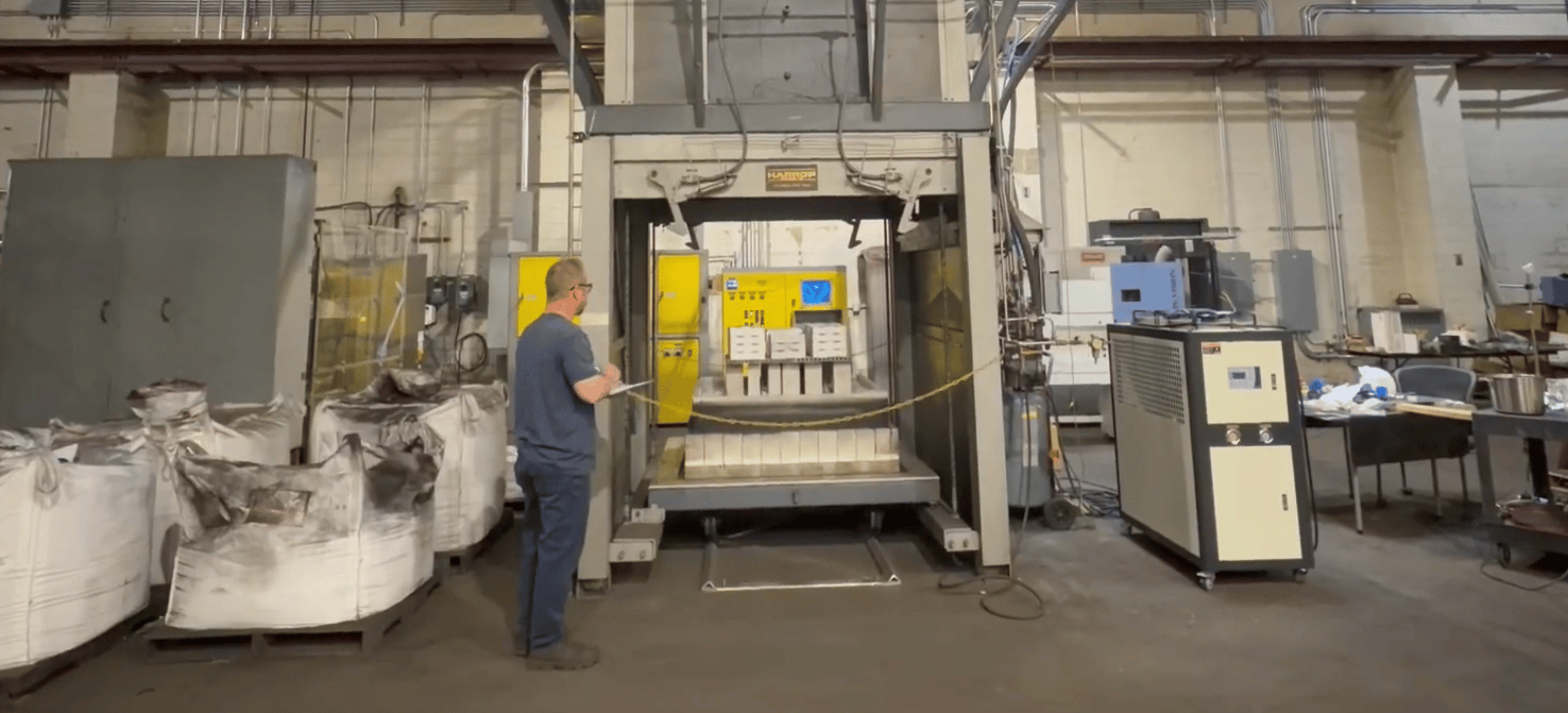
Over the 18-month program, the team will move Obsidia from batch production toward semicontinuous manufacturing, produce the material at larger scale and validate it in prototype full cells. The work is focused on proving that Obsidia can be made repeatedly, economically, and at useful scale.
Beyond the funding, the award is a meaningful vote of confidence in Obsidia from the DOE as a domestic critical-material solution that supports the goal of U.S. energy dominance. The project targets a major U.S. supply-chain vulnerability: reliance on imported battery-grade graphite. Obsidia combines silicon oxycarbide (SiOC) chemistry with abundant domestic carbon feedstocks, including abundant American coal.
Obsidia’s manufacturing path is also a core advantage. Many silicon-rich anode materials depend on chemical vapor deposition, intricate nanoscale structures, or other complex production steps. Obsidia is made through chemical mixing and thermal processing that can be adapted to familiar industrial equipment. C-BATT expects this simpler production route to shorten scale-up time, reduce factory complexity, and keep capital costs lower than many silicon-based approaches. Obsidia is also designed for use with conventional lithium-ion battery electrode processing.
“Battery companies do not just need promising chemistry. They need a material they can buy in volume and run through practical manufacturing,” said Josh McConkey, director of commercialization at C-BATT. “This project begins the work of proving that Obsidia can meet these demands while strengthening the American battery-material supply chain.”
The project team will develop, qualify, and optimize Obsidia made with cleaned waste coal fines, demonstrate semicontinuous production, and validate performance in full pouch cells. The team will also complete a life-cycle assessment, techno-economic analysis, and manufacturing feasibility studies that compare the domestic process with battery-grade natural graphite produced overseas.
Semplastics will lead SiOC resin development and manufacturing scale-up. C-BATT will lead Obsidia formulation, qualification, and battery-cell validation. CONSOL Innovations will support domestic feedstock selection, pyrolysis scale-up, and the project’s techno-economic and life-cycle work.
The project team expects the Obsidia scale-up process to progress rapidly, due to C-BATT’s extensive work on simplifying the anode material synthesis processes. The DOE project selection is available here.
About C-BATT
Founded in 2023, C-BATT is a joint venture between X-BATT® and CONSOL Innovations. C-BATT is developing Obsidia™, a domestically sourced anode material designed to provide a higher-capacity alternative to graphite while working with conventional lithium-ion electrode processing. The C-BATT battery lab is in Oviedo, Florida and scale-up of the manufacturing process is proceeding in Triadelphia, West Virginia.
About Semplastics
Semplastics is an advanced materials company based in Oviedo, Florida, developing polymer-derived ceramic materials and manufacturing processes for battery, aerospace, thermal, and industrial applications.
About CONSOL Innovations
CONSOL Innovations LLC, a wholly owned subsidiary of Core Natural Resources, Inc., creates long-term value through innovations in carbon products, carbon materials, and carbon management. With primary operations in Triadelphia, West Virginia, the company develops carbon-based solutions for growing industries including aerospace, building products, and energy storage. Learn more at Core Natural Resources.